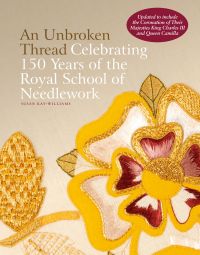
An Unbroken Thread
£37.50
Rare Special Editions available from ACC Art Books – More Information
Embroidery is the essence of China’s 1,000-year-old handicrafts, and Suzhou embroidery, renowned for its delicate needlework and elegant artistic conception, is representative of them.
This exhibition, titled ‘The awakening of embroidery’, aims to break through the traditional perception of embroidery as merely a ‘skill’ or an ‘appendage of images’. It explores how needlework itself can become an independent aesthetic subject and a spiritual expression.
The exhibition presents the transformation process from ‘skill’ to ‘art’ and then to ‘way’ through three progressively layered chapters, ultimately pointing to the era of needlework’s self-aware expression.
This event is organised by Guangxi Normal University Press and ACC Art Books.
From 5 March 2026, “Suzhou Embroidery: The Awakening of a 1000-Year Tradition” will open to the public at the Exhibition Pavilion of the Royal Geographical Society. Grounded in Suzhou embroidery, a millennia-old Chinese craft tradition, the exhibition presents the results of years of cross-border collaboration between contemporary Chinese artist Wu Jian’an and Suzhou Embroidery Master Yao Huifen and Yao Huiqin, together with their team of embroiderers, exploring the transformation and reconstruction of traditional craftsmanship within a contemporary context.
Suzhou embroidery originated in Suzhou, Jiangsu Province, China — a historic city in the Jiangnan region, known for its canals and rivers, deep historical legacy, and rich cultural heritage. As one of the most representative embroidery traditions in China, Suzhou embroidery has a history of more than two thousand years and has been recognised as part of China’s National Intangible Cultural Heritage. Over time, it developed a distinctive artistic language, and Suzhou embroidery is a representative among them, renowned for its delicate stitches and elegant artistic conception.
Building upon this historical legacy, the exhibition reconsiders the position of embroidery in a contemporary context. Through a close examination and experimentation with stitch structures and modes of expression, it seeks to move beyond the long-standing perception of embroidery as merely a “skill” or an “appendage of images,” allowing the stitch itself to assume a more independent aesthetic value and expressive space.
The exhibition presents approximately 58 works, bringing together a decade of collaborative creation and sustained dialogue between the contemporary artist and the embroidery master.It unfolds through three progressive chapters:
– Gene Bank • Suzhou Embroidery Needlework Samples,
– Language • Confessions of Traditional Needlework Techniques, and
– Autonomy • Independence and Expression of Technique.
Beginning with the technical foundations of craftsmanship, the exhibition gradually moves toward the reconfiguration and extension of stitch language. Through this structure, it presents the transformation process from “technique” to “art” and then to “method,” tracing the emergence of a self-aware language of the stitch, and offering a renewed perspective on traditional craftsmanship in a contemporary context.
This exhibition begins with the technical “genes” of Suzhou embroidery, returning to the structural origins of traditional craftsmanship while rearticulating its linguistic form. It showcases 49 samples of traditional Suzhou embroidery needlework, highlighting the form, rhythm, and compositional logic of the needlework itself. These samples serve as the “gene bank of Suzhou embroidery,” functioning as the starting point for understanding the essence of embroidery techniques. By foregrounding the stitches themselves, the exhibition draws embroidery away from the surface narrative of images and back to its technical essence.
The exhibition also presents seven contemporary embroidery works based on the silk-colored fan painting Skeleton Puppet Play by Li Song of the Southern Song Dynasty. These works employ nearly fifty traditional Suzhou embroidery stitches and depart from conventional needlework structures, generating tensions among diverse stitch forms within a single composition. By disrupting the established orientation and expressive structure of embroidery, the works reconstruct its language, revealing the intrinsic qualities of the stitches and producing a visual tension that embodies an aesthetic of “harmony in difference.” This series was first exhibited at the China Pavilion of the 57th Venice Biennale.
The exhibition also showcases two newly commissioned abstract embroidery works that detach themselves from imagery. Using a single colour of silk thread, and through the interweaving, overlapping, and rhythmic variation of needlework techniques, the works construct rich textures and layered effects of light and shadow. These squares are no longer “carriers of patterns,” but pure expressions of the stitch itself — the stitches become brushstrokes, the silk threads become pigments, and embroidery emerges as an autonomous art form.
“Suzhou embroidery should be like fungi — alive, driven by an intrinsic life instinct, growing
freely and exuberantly. The stitches are like different species of fungi, each with its own patterns of
proliferation and behavioural characteristics. Human intervention lies in the act of random selection,
determining the order in which the stitches enter the field and the initial territory they occupy. This
is a stage for evolution, and the moment of true awakening for the stitches.”
— Wu Jian’an, Contemporary Artist
“I have devoted my life to learning this craft. Arriving at this new creative state feels more like a
return — returning to the full range of stitches and allowing the stitches to express themselves,
gradually moving from figuration to abstraction. For me, creation has always been a process of
following its natural course, letting things unfold organically. When there is no deliberate force or
contrivance, it sometimes becomes a form of “action through non-action.” Or perhaps it is a
transformation from “technique” to “art,” and ultimately to the “Dao.”
— Yao Huifen, Suzhou Embroidery Master
Wu Jian’an
Born in Beijing in 1980, his ancestral home is Jinshan, Shanghai. He is currently a professor and doctoral supervisor at the Central Academy of Fine Arts, and the vice dean of the School of Experimental Art and Technological Art. External expert of the National Museum Research Institute of China, member of the Academic Committee of the Prince Gong’s
Mansion Museum, researcher of the Research and Protection Center for Traditional Chinese Skills, deputy director of the Traditional Craft Collaborative Innovation Working Committee of the China Arts and Crafts Association, member of the Academic Committee of the Chengdu Museum, member of the Art Committee of the 798 Art Zone in Beijing,
member of the Academic Committee of the Beijing Zoo. As a highly creative and speculative artist, Wu Jian ‘an has always hoped to interpret the “past” with contemporary concepts, explore the hidden issues related to contemporary social and cultural realities within it, and construct the transformation and integration of tradition and the contemporary from multiple aspects such as concepts, contents, and artistic forms. Through astonishingly large- scale replication and handcrafted collage, The final form of the work is often presented as a huge installation with a highly mysterious visual experience. His representative works include the “Daydream” series, “Nine Heavens”, “Seven Shells”, “Five Hundred Strokes” series, etc. His representative works have been exhibited in world-renowned museums and art galleries such as the Metropolitan Museum of Art in New York, the Museum of Fine Arts in Boston, and the Los Angeles County Museum of Art.
Yao Huifen
A Suzhou embroidery artist. Senior Master of Arts and Crafts, Master of Chinese arts and Crafts, Representative Inheritor of the National Intangible Cultural Heritage Project (Suzhou Embroidery), and Expert enjoying special government Allowance from The State Council; The fourth-generation successor of Shen Shou, the “God of Needlework” of his generation. Yao Huifen was born into a family of embroidery artists in Suzhou and has been engaged in the art for forty years. Since 1991, the Suzhou embroidery artworks she has created have won dozens of national-level arts and crafts awards and the highest award of Chinese folk arts and crafts – the “Mountain Flower Award”. She is hailed as the “Inheritor of Suzhou Embroidery”, “Chinese Skillful Woman”, and has been honored with titles such as “Jiangsu Master Craftsman”, “One of the First Batch of Zijin Cultural and Creative Talents in Jiangsu Province”, “Advanced Individual in National Intangible Cultural Heritage Protection Work”, and “Annual Figure of China’s Intangible Cultural Heritage”. Over the past decade or so, Yao Huifen has been dedicated to researching the style and innovation of contemporary Suzhou embroidery and has pioneered the “simple needle embroidery” technique. Her works have been collected by many museums both at home and abroad, such as the British Museum, the White Rabbit Art Museum in Australia, the National Museum of Chinese Arts and Crafts, the National Silk Museum of China, the Liaoning Provincial Museum, and the Suzhou Museum, as well as by famous people like architect master I.M. Pei, US President George W. Bush, UNESCO Director-General Bokova, and Azoulay. In 2017, the contemporary Suzhou embroidery series conceived by Wu Jian ‘an and designed and produced by Yao Huifen, Yao Huiqin and their team of embroiderers was successfully selected and participated in the exhibition of the “57th Venice Biennale China Pavilion”, setting a precedent for contemporary Suzhou embroidery to enter the world’s top art exhibitions. Its artistic aesthetic construction is regarded as a milestone in contemporary Chinese embroidery.
Yao Huiqin
Yao Huiqin, senior researcher-level master of arts and crafts, is a famous figure in Jiangsu’s arts and crafts, the first batch of Chinese young embroidery artists, and the inheritor of the national intangible cultural heritage project of Suzhou embroidery. She is the fourth- generation inheritor of Shen Shou, a master of modern simulation embroidery.
Yao Huiqin was born into a family of embroiderers in Suzhou. Since childhood, she has been learning embroidery together with her elder sister Yao Huifen. Under the guidance of Mu Zhihong, the third-generation inheritor of Shen Shou, the “God of Needlework” of modern Suzhou embroidery in China, and Ren Huixian, a master of Chinese arts and
crafts and the artistic director of Suzhou Embroidery Research Institute, she systematically studied the theory and techniques of Suzhou embroidery, and has mastered all kinds of needle techniques and embroidery skills of Suzhou embroidery proficiently. She specifically studied oil painting techniques and creation at the Central Academy of Fine
Arts. When creating embroidery works, Yao Huiqin can not only flexibly apply dozens of traditional embroidery techniques of Suzhou embroidery, but also is particularly skilled at combining oil painting techniques with the principle of random stitch embroidery to carry out embroidery. She integrates “painting principles” and “embroidery principles”
to create oil painting works, making her embroidery pieces have distinct artistic individuality and originality. For over three decades, Yao Huiqin has won dozens of national-level arts and crafts awards for her exquisite Suzhou embroidery works. She is hailed as the “successor of Suzhou embroidery” and the “ingenious woman of China”. In 2017, the
contemporary Suzhou embroidery series conceived by Wu Jian ‘an and designed and produced by Yao Huifen, Yao Huiqin and their team of embroiderers was successfully selected and exhibited at the “57th Venice Biennale”, setting a precedent for Suzhou embroidery art to enter the world’s top art halls.
Please log-in or create an account to see your recent items.