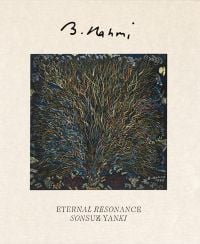
Bedri Rahmi Eyüboğlu: Sonsuz Yankı
£70.00
Rare Special Editions available from ACC Art Books – More Information
Bedri Rahmi Eyüboğlu
He was born in 1911 in the Görele district of Trabzon. He was the second son of a family of five. Due to his father, Rahmi Bey, who was a district governor, they moved first to Pınarbaşı and then to Havza. In 1920, the family settled in Kütahya.
In 1925, his father became a member of parliament for Trabzon. The family returned to Trabzon, and he enrolled in Trabzon High School.
In 1927, Zeki Kocamemi was appointed art teacher at Trabzon High School. After this period, Bedri Rahmi’s love of painting blossomed. His correspondence with his older brother, who was studying in France, sparked a sibling-family correspondence. In 1929, he entered the Painting Department of the Istanbul Academy of Fine Arts, where he studied under Nazmi Güran and İbrahim Çallı.
In 1931, he went to Paris before earning his diploma. He studied French in Dijon and Lyon. Meanwhile, he copied the paintings of masters he admired, such as Gauguin and El Greco, from the museums where they were held. Van Gogh, Gauguin, and Cézanne were the masters who committed him to his profession. In 1932, he worked for about a month at the André Lhote workshop in Paris. He met Ernestine Letoni, with whom he would later share his life. In 1933, he went to London. He returned to Turkey at the end of the year. In 1934, he began working as a painter at the New Adam. He won third place in the Academy Diploma Competition with his painting “Road Construction.”
On December 27, 1934, he participated in the Group D Exhibition with 30 paintings. His first solo exhibition was opened by Ernestine Letoni at the Hasefler Gallery in Bucharest on January 1, 1935. He married Ernestine Letoni, whom he called “Eren,” in 1936. He won first place in the 1936 diploma competition of the Academy of Fine Arts with his work “Hamam.”
He participated in the Turkish Painting and Sculpture Exhibition, which was taken to the Soviet Union, with three paintings. In 1937, he became Leopold Levy’s assistant at the academy. He began preparing a book of studies on Nazmi Ziya Güran. He was among the writers for the magazine “Ses” (Ses), published on November 1, 1938. On October 31, 1939, he shared third place with Arif Kaptan with his work “Figure” at the First State Painting and Sculpture Exhibition. On November 9, 1939, he was enrolled in the reserve officer school to complete his military service. That same year, his son, Mehmet Hamdi Eyüboğlu, who would later carry out works that would immortalize his father and mother, was born.
He completed his military service in 1941. His first poetry book, “Letters to the Creator,” was published. He won second prize at the Fourth State Painting and Sculpture Exhibition, which opened on October 31, 1942. In 1943, he created his first murals for the Ortaköy Lido Swimming Pool. Between 1945 and 1947, he created important portrait series such as “Portrait of Mari,” “Alice I,” and “Alice II.” In 1946, he created his second mural (a fresco on the theme of “Kızılı Kız” [The Abduction of a Girl]) above the doors at the entrance of the Ankara Grand Theater (opera). His paintings, submitted to the international exhibition organized by UNESCO in Paris in November 1946, attracted attention. In 1947, he led the establishment of the “Group of 10,” comprised of young artists. His second poetry book, “Karadut,” was published in August 1948.
In 1950, he organized a “Retrospective” exhibition of 150 paintings at the Ankara Faculty of Language, History, and Geography. He traveled to Paris for a few months. There, he was deeply impressed by the Museum of Man. Driven by the belief that “beauty must be useful,” he brought a new interpretation to the “printing” tradition. In 1950, he designed the Kariye Mosque and became interested in Byzantine mosaics. In 1951, he decorated the “Small Stage.” He painted mosaic-like paintings with paint until 1951. On March 21, 1951, he opened his first “Writing Exhibition.” He began writing for the Yeni Sabah newspaper. From January 1952 until 1958, he wrote regularly for Cumhuriyet newspaper. In 1953, his prints and original prints were exhibited at the Philadelphia Print Club. On September 14, Times magazine dedicated two color pages. In 1954, Bedri Rahmi won an award in a competition organized by Steuben Glass for his motif titled “Turkish Tray,” and the motif was carved into crystal and displayed. Between 1954 and 1957, he created panels for the Hilton and Divan hotels and the KLM headquarters in Istanbul. He was invited by the Yugoslavian and Dutch governments. In 1955, he was appointed head of the committee that selected the paintings to be installed in the Turkish Grand National Assembly (TBMM) building. In 1956, he received an honorary award at the Sao Paulo Biennial. That same year, his book “My Dear Anatolia” was published. In 1957, Bedri Rahmi participated in the Tokyo Biennial of Original Prints and published his book “Three at Once.” That same year, he turned his attention to mosaic work, fusing motifs from folk arts such as weaving, rugs, scarves, and embroidery with a unique style. In 1958, he received a gold medal for his 227-square-meter work for the Turkish pavilion at the Brussels International Exhibition. In 1959, he created a 50-square-meter panel for NATO headquarters in Paris.
Between 1960 and 1970, she took a break from writing. In 1961, she went to the United States. During this period, she turned to abstract forms with rich colors. She experimented with unseen and unknown colors, using plastic glue, plastic paints, sand, sawdust, and crumpled Japanese paper. As she herself admitted, the “American Period” added another dimension to her art. She served as a visiting professor at the University of California at Berkeley for two years. In August 1961, her motif, “Anatolian Peasant Woman Carrying Her Children on a Donkey,” was printed as a postcard in the United States to benefit UNICEF Children’s Fund. In December 1962, the New York Museum of Modern Art purchased her painting “Chain.” Between 1963 and 1964, she experimented with various materials, including panels for the Vakko factory, the Karaköy sweet shops, and the Dry Goods Market. Her final panel is “Pigeons,” located at the entrance to the Etap Hotel. In 1970, he once again produced paintings with a social context. In 1972, he received first prize at the 33rd State Painting and Sculpture Exhibition. He passed away on September 21, 1975.
Please log-in or create an account to see your recent items.