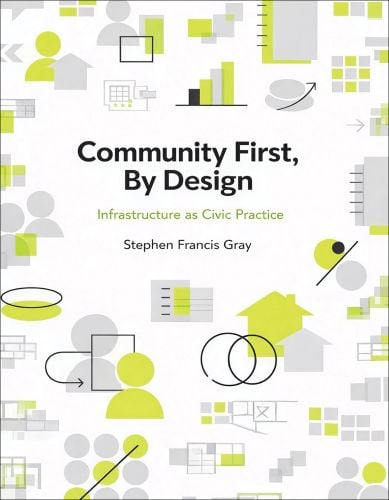
Community First, By Design
Infrastructure as Civic Practice
- Infrastructure reuse offers one of the clearest and most consequential opportunities to influence who benefits from city design by reshaping governance, sequencing, and partnership decisions before construction begins
- Reveals where leverage sits in infrastructure reuse—upstream in land control, sequencing, partnership structure, and governance decisions that shape outcomes long before construction begins
- Positions infrastructure reuse as one of the most consequential civic design opportunities of our time—where form, governance, and land economics intersect
- Combines analytical diagrams, axonometric studies, timelines, and research graphics with practitioner case studies—making the book both conceptual and operational
- Draws from nearly 40 reuse projects to show how design decisions reverberate through markets, policy, and communities
- Written for cross-sector practitioners: designers, planners, public agencies, nonprofit conservancies, foundations, and community-based organizations
- Offers a clear framework—Typologies and Tools—that helps practitioners act upstream of form-making
- Designed as a working manual, with nonlinear navigation and cross-referenced tools suitable for studio, practice, or public meetings
- Expands a widely used digital toolkit (toolkit.highlinenetwork.org) into a comprehensive print field guide for designers and civic leaders shaping the next generation of public infrastructure.
Across North America, obsolete infrastructures are being re-imagined as platforms for public life in the twenty-first century. Celebrated for their design ambition and catalytic potential, these projects promise to reconnect neighbourhoods and transform landscapes—but also risk intensifying uneven development and displacement. Community First, By Design reveals why infrastructure reuse projects so often encounter similar equity challenges, regardless of location or intent. Organised around five recurring typologies—rail and linear corridors, waterfronts, highways and bridges, cultural networks, and legacy park systems—the book links physical form to inherited histories, development pressures, and institutional leverage, offering practical pathways forward. Drawing on nearly 40 reuse projects, Stephen Francis Gray shows how decisions about sequencing, land control, partnership structure, and governance shape outcomes as decisively as design itself—often long before projects become publicly visible.
At its core is the award-winning Community First Toolkit: 18 actionable tools, collaboratively developed by Harvard and the Urban Institute for the High Line Network, that help practitioners clarify purpose, align internal systems, structure partnerships, and embed accountability while leverage still exists. Neither manifesto nor mitigation strategy, this book positions equity as a design discipline—exercised through deliberate, cumulative decisions that shape how cities evolve.
- Publisher
- ORO Editions
- ISBN
- 9781966515753
- Publish date
- 10th May 2027
- Binding
- Paperback / softback
- Territory
- World excluding USA, Canada, Singapore, Thailand, Vietnam, Cambodia, Indonesia, Brunei, Philippines, Malaysia, and Australasia. India non-exclusive.
- Size
- 229 mm x 178 mm
- Pages
- 220 Pages
- Illustrations
- 200 color
Distributed by ACC Art Books
Our Catalogues
Please log-in or create an account to see your recent items.