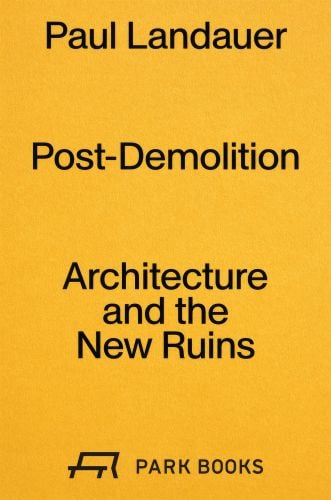
Post-Demolition
Architecture and the New Ruins
- Most of our built environment dates from the 20th century and is largely the cause of the ecological problems we face today
- Paul Landauer’s essay examines the technical and theoretical questions raised by the potential restoration of this challenging legacy
- A timely, readable text set against the backdrop of climate change and increasingly scarce resources
- Climate change and scarce resources require new concepts of construction, a rethinking of the location and organisation of human settlements, and profound reorganisation of territories and the built environment
Society—and, with it, architecture—faces the major paradox that a new world must be built while we no longer have the means to do so. Rising sea levels and increasingly frequent natural disasters require a rethinking of the location and organisation of human settlements. Our planet’s limited and increasingly scarce resources compel a profound reorganization of territories and the built environment.
This environment was mainly built throughout the 20th century and is largely the cause of the ecological problems we are facing today. To preserve it, and at the same time address these problems, its characteristics must be reconsidered. We must continue to use already developed areas and existing structures, rather than consume new land and demolish and replace unwanted structures.
Post-Demolition explores how contaminated soil and buildings—potential or actual ruins—can be transformed into the foundations of a sustainable world. Yet, to simply redesign existing buildings will not do. We must also grapple with the technical and theoretical questions raised by the restoration of this heritage.
- Publisher
- Park Books
- ISBN
- 9783038605256
- Publish date
- 4th Jan 2027
- Binding
- Paperback / softback
- Territory
- World excluding Austria, France, Germany, Switzerland, Puerto Rico, United States, Canada, and Japan
- Size
- 230 mm x 150 mm
- Pages
- 192 Pages
- Illustrations
- 75 b&w
Distributed by ACC Art Books
Our Catalogues
Please log-in or create an account to see your recent items.