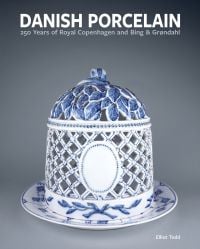
Danish Porcelain
£125.00
Rare Special Editions available from ACC Art Books – More Information
Blue-and White porcelain is an iconic part of Danish design. Christmas plates, in particular, grace the walls of many Danish-American community centers – including ours! MoDA has gathered a near-complete collection of Christmas plates over the years, representing dozens of families’ connection to Danish ceramics. Charming as they are, though, these blue-and-white pieces represent only a small fraction of what Danish ceramics studios excelled at.
Denmark has been making extraordinary pottery since the Mesolithic, some six thousand years ago. However, the exhibit’s story begins in 1775, with the opening of Royal Copenhagen. The oldest pieces in the gallery date to this time period and explore how Royal Copenhagen became enmeshed with European elite culture. Borrowing freely from both Danish and international artists, Royal Copenhagen thrived under a royal monopoly for generations. This time period produced the Blue Mussel pattern (still produced today) and the Flora Danica service, widely regarded as one of the treasures of the Danish royal family.
In Danish ceramics, the Art Nouveau movement (roughly 1884-1925) laid the foundation for much of what Danish-Americans associate with Danish ceramics. The first animal figurines were created by Royal Copenhagen by 1886, and B&G created the first Christmas plate in 1895. Even pieces like the “Seagull” service (at one time the single most popular series of porcelain dinnerware in Denmark) were created in 1895 by Fanny Garde, one of Pietro Krohn’s designers. The brilliant blues, greens, pinks, and whites we associate with “porcelain” are all products of the innovation and technical prowess of this period. It paid off; Danish ceramics studios won award after award at international competitions, and Americans like Louis Tiffany became fans of Royal Copenhagen’s work.
The first echoes of a new era begin in the 1910s, as Art Nouveau fell out of popularity in Europe. Artists like Hans Hjörth and Patrick Nordström began popularizing stoneware ceramics. Over the 1910s and 1920s, they slowly become more popular, and more and more artists begin exploring single-color glazes and new, minimalist shaped. By 1930, the rise of new studios like Saxbo Stentoj ensured that stoneware would dominate the Danish ceramics scene. These studios would largely shutter by the 1970s, opening the door to contemporary, experimental sculpture.
Danish Ceramics: Beyond Blue and White is an exploration of both artistic prowess and cultural tradition. The exhibition asks visitors to explore what makes Danish ceramic art uniquely Danish. Visitors are repeatedly confronted by non-Danish symbols, particularly from China, Japan, and Persia. Some pieces were designed by non-Danes living in Denmark, or by Danes living around the world. Even Royal Copenhagen’s production now is largely based in Thailand, disrupting any material connection between designer, molder, and painter.
Despite these challenges, certain shared ideas emerge. A cream jug from the 1790s has a greyish body, a quirk of impure porcelain clay. Nearby, a vase from 1917 intentionally replicates that greyish color as an artistic statement, while it also appears in Sandra DaVolio’s “White Frills” from 2006. Together, the pieces tell a story of how Danish artists worked together, handing down ideas generation to generation. The “Danishness” of Danish ceramics is found the communities of potters and artists who make them, and that chain of connection remains unbroken.
Please log-in or create an account to see your recent items.